Welcome! This site is intended to provide past, present and future goings-on in the Wright family that settled in Montgomery and Pike Counties in Arkansas.
The Wright Family And Dodge City
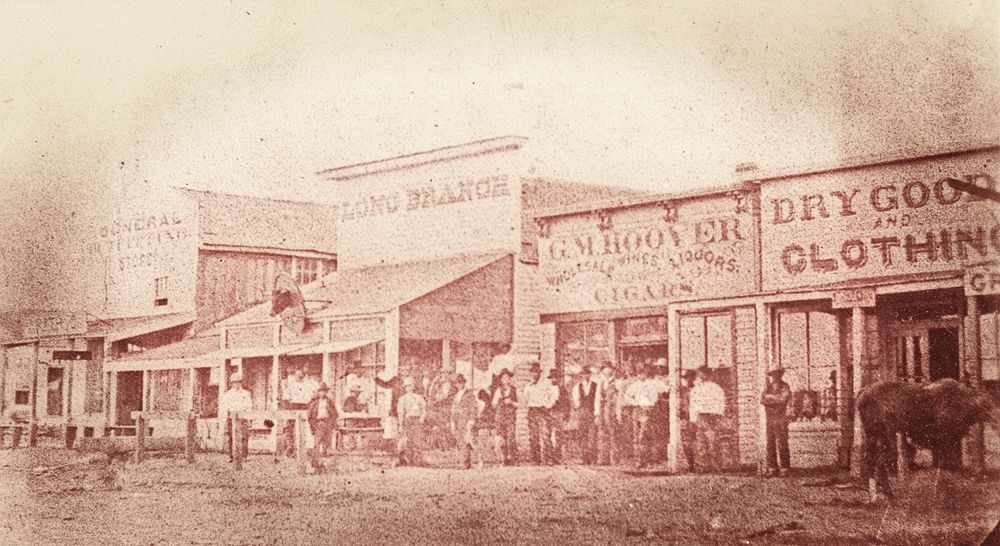
Dodge City – 1870s
My father, Joel Samuel Wright, was a great fan of the Gunsmoke television series. As far back as I can remember, Gunsmoke was on during primetime in color (well, after we got a color set). I enjoyed the drama, the comedy, and the cozy relationship between the characters. The banter between Doc and Festus (or Chester, depending on your age) was classic!
Watching the show, we saw gunslingers pass through, most to be shot by Marshall Dillon. We also saw heart-rending stories of life on the frontier, with families fighting off Indians, wild animals, or outlaws. While good people always stepped up to help one another, only the strongest were successful out there and, in many episodes, people turned back to the east.
The most common site in the show was the Long Branch Saloon. Miss Kitty Russell was the proprietor (by the way, no one bothered to speak about the fact that she was a madam. In a day when the television censors were very active, it was just something everyone simply overlooked). She ran that place with an iron fist! Why, there were seldom shootouts in there, and you rarely saw someone try to take advantage of her ladies (the ones being paid to be taken advantage of).
While I enjoy watching Gunsmoke from time to time, I was not a diehard fan of the old west. Modern historical movies such as Tombstone and Wyatt Earp were not movies in which I had much interest. However, I did always love a good John Wayne movie and would sit through a good Clint Eastwood Spaghetti Western.
But last weekend that changed a bit. While sitting in the Short Family Reunion at Old Mt Tabor Cemetery near Glenwood, AR, I heard a passing anecdote of a gunslinger and gambler named Short who was famous for killing a more famous gunslinger. I was instantly intrigued, and while the research was speaking, I pulled out my phone and began a search for this man. The search returned the name Luke Short, born in 1848 in Polk County, Arkansas.
My first reaction was to drill down his family tree, but as I read his history another name came into the picture. In 1881, Short arrived at Dodge City and began working as a dealer at the Long Branch Saloon. At this time the saloon was owned by William H. Harris and Chalkley “Chalk” Beeson. In 1883 Chalk sold his interest to Short.
At this point, I was in a quandary. Did I research Short or Beeson? You see, While Edmund Wright’s fourth wife and my great grandmother was a Short, we Wrights are also Beesons! So, I had a decision to make right then and there! You may ask why I was surfing on my phone while a researcher was talking about Short family history. I can only say to you that I have ADHD, and this is normal behavior!
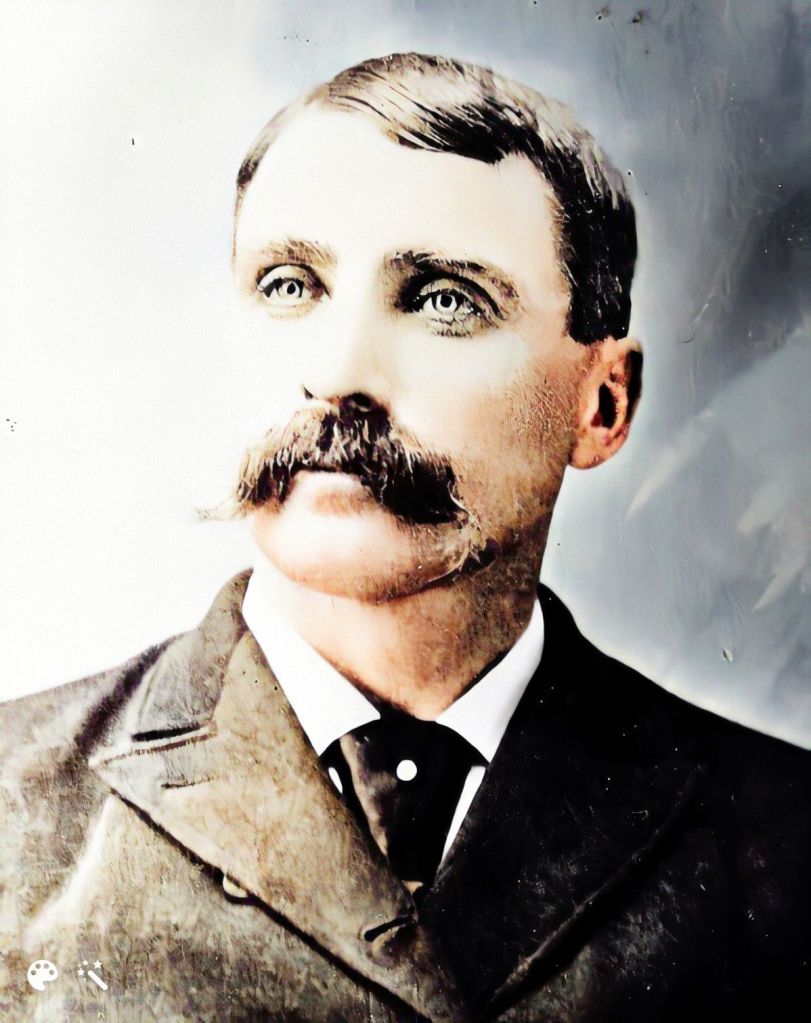
So, down the rabbit hole I went! Something told me that Chalk Beeson was family. Besides just having a gut feeling, the main rationale I used was that the Beeson name is far less common than the Short name.
It turns out that Chalk Beeson was the great-grandson of none other than Henry Beeson. Henry also happens to be the great-grandfather of Edmund Wright. Henry’s daughter, Phebe Beeson-Schooley, is sister to Richard Beeson, Chalk’s grandfather, making Edmund and Chalk second cousins.
Chalk grew up in Columbiana County, Ohio. If this sounds familiar, it is because Edmund’s great-grandfather Joseph Wright settled in and died in Columbiana County. Henry Beeson, after founding Uniontown, PA in 1776 with his brother Jacob, had taken his family to help homestead Columbiana County, OH around the same time the Wrights and the Schooleys arrived. Being Quakers, the Beeson and Schooley families were no doubt very close. Henry’s daughter, Phebe, married John Schooley on March 26, 1807. Their daughter Anne Jane Schooley married Thomas Wright, our Edmund’s father.
Chalk left Ohio at the age of eighteen and made his way to the frontier… Kansas. Chalk was obviously a brilliant man. He was an accomplished musician, an astute businessman and a forward-thinking entrepreneur. One of the first things Chalk did after reaching Kansas was become owner of his own saloon, the Saratoga. This saloon was not the type of saloon you are accustomed to hearing about in the west. In the Saratoga, instead of being entertained by prostitutes, you were serenaded by a full orchestra! I have to attribute this to Chalk’s Quaker heritage.
Chalk also served as Ford County Sheriff for a time. One of his accomplishments as Sheriff was tracking down the Doolin gang. He also participated in a few gunfights. Chalk, along with his partners, Bat Masterson and Bill Hickock, kept the streets of Dodge City safe.
Another venture of Chalk’s was as a buffalo tour guide. Through this, he became friends with the Grand Duke Alexis of Russia. Others with whom Chalk became acquainted through his tours included Kit Carson, General Phil Sheridan, and General George Custer.
Beeson was successful in all his endeavors, including farming and ranching. But one of the most unexpected successes was his band, The Dodge City Cowboy Band, which he formed in 1879. This band was indeed made up of cowboys. It performed for all occasions in Dodge, and even performed in Washington, DC at the inauguration of Benjamin Harrison in 1889.
In 1932, Chalk’s son Merritt opened the Beeson Museum in Dodge City. It was open for 32 years. In 1964 its collections were sold to the Boot Hill Museum.
So, if you travel to Dodge City, keep your eyes open. While you never heard his name on Gunsmoke, Chalkley Beeson was and still is a pretty big deal there!
And Then There Was One – The Grandchildren of Edmund Wright
The legacy left by Edmund Wright included nine children, scores of grandchildren, and likely thousands more direct descendants.

Note: Much of the information in this post is taken from the books The Wright Book and A Short Line Across America by Pauline Wright.
I’ve come to realize that many people don’t know a lot about their family’s history. As a youth, I had always assumed people were interested in their genealogy, and knew their family tree. But this just isn’t the case. And it’s not necessarily a bad thing. People are simply wired differently. Some are focused on the present and the future, and see less value in the past. Others may feel they don’t really want to know more about their family. Still others simply don’t know how to go about learning their family’s history.
I have always been eager to know as much about my family as possible. Where did they come from? What motivated them to take up roots and settle further west? As for my ancestry, the Short family can easily be traced all the way back to Scotland. The Childers family comes from South Carolina. The Grants and Hewitts from Georgia. The Wrights, Edgars, and Schooleys all lived together in Virginia before making their way west. All these families, and more, are my ancestry.
Eventually, the Wrights and others made their way to Montgomery County, Arkansas. If you are a multi-generation Glenwood, Arkansas native, odds are good that you, in some way, are related to a Wright. You may not even realize it, but if you are a Short, Jester, Collum, Childers, Grant, Tallant, Tidwell, Standley, Standridge, Smith, Forga, Wisenhunt, Wisenant, Pettyjohn… I can go on and on… there are Wrights somewhere in your family. And if you aren’t related to the Wrights, then it’s likely that your family was, in some way, ministered to by a Wright.
The reason? Edmund Wright. Much of Edmund’s large family has remained in the Pike/Montgomery County area. And his family has had a profound impact on the area to the present day.

Edmund was born in Portage county, Ohio in 1839. He was the son of Thomas and Anne Schooley Wright. Thomas, a second-generation Baptist (His father, Joseph, was disowned by the Quakers after marrying a Baptist girl, and Thomas’ wife Anne, was likewise disowned for marrying him). He was a railroad mechanic, and an entrepreneur and businessman. He was well known for his massive barn, into which a horse and wagon could drive in on three separate levels.
In 1859, when Edmund was twenty, the family took up roots and moved to Trinity County, Texas. Thomas had made a land deal, one that prompted him to sell virtually all his property in Ohio. Unfortunately, after arriving in Texas, Thomas found he had been swindled.
Thomas died and was buried near Grovetown, Texas. Edmund’s sisters all married in Texas, while Edmund made his way to Simsboro, Louisiana. There, he met and married his first wife, Narcissa Summerlin. They had three children, Mary Cornillia, Martha Edna, and Thomas Justus.
In 1870 the family moved to Pike County, Arkansas and settled about three miles west of Glenwood. Two years later, Narcissa died. She is buried in a single plot in the middle of a field there where Edmund’s homestead was located.
Edmund was ordained as a minister in 1873, and became pastor of Antioch Missionary Baptist Church. This is now known as Oak Grove Baptist Church in Caddo Gap, just a couple miles west of what is known as the Hopper Bridge on highway 240. Unbeknownst to Edmund, he would there be ministering to the family of a future daughter-in-law, Loretta Grant.
In 1874, Edmund married Ann Tallant. They were parents of James Labon and John Edgar. in 1878, Ann died, and was one of the first to be buried in what became known as the Mt. Tabor Cemetery.
In 1880, Edmund returned to Simsboro, Louisiana, where he and his daughters were all married. His daughters married brothers… John and Thomas Smith. Unfortunately, Edmund’s wife, Mary Vance, died in childbirth.
By 1886, Edmund and his daughters, the Smith families, were back in Montgomery County (Yes, if you are a Smith from Glenwood/Tabor or possibly Hot Springs, you could be a Wright as well). He was, by that time, also a medical doctor, and had married Leah Elvira Short, to which his last four sons, Joel, Bun, Wibb, and Floyd, were born.
Edmund served as a farmer, doctor, and pastor for many years, pastoring a few Missionary Baptist churches in the area, including Bethel, Mt. Pisgah, and the aforementioned Antioch. He even taught a school out of his house in Lucky (North of hwy 70 and the Mt. Tabor community).
In 1899, at the age of fifty-nine Edmund died and was buried on his property, the Mt. Tabor Cemetery, next to his wife, Ann Tallant, and his mother, Anne Jane Schooley. His tombstone spells his name as Edmond, and adds almost a month so his lifespan.
The legacy left by Edmund included nine children, scores of grandchildren, and likely thousands more direct descendants. It was once estimated that, at the death of Edmund’s son Joel’s widow in 1992 at the age of 99, Joel and Loretta “Retter” Wright alone had as many as one hundred fifty direct descendants.
Many of Edmund’s descendants have been called into ministry over the decades. His son, Thomas Justus, took the gospel into Oklahoma. Thomas’ descendants then continued on, all the way to California. Many descendants are still pastoring today. Others serve as deacons, in music ministry, women’s and children’s ministry, teaching bible studies, and in other capacities in their churches. His descendants have taught and are now teaching children of all ages, from elementary schools to universities.
I often tell people that my great grandfather was born in 1839, and I enjoy watching their eyes widen when they consider that was over one hundred eighty years ago. I love being part of a massive family that stretches out over so many years. Why, some of Edmund’s grandchildren were older than his own children!
In January 2020, five of Edmund’s grandchildren were still living – Joe Floyd Wright, Darrel “Buster” Wright, Joel “Coot” Wright, Hazel Britt, and Haskel Wright. Each of them continuing to serve as much as they were able. And there was not a one of these that you couldn’t sit down with and gain a greater Godly insight on life. I know that I have spent many hours gaining wisdom from Dad (Joel) and my uncle Buster.
Additionally, some of these grandchildren, extremely knowledgeable, not only about the Wright family, but the history of Montgomery and northern Pike counties, might be able to sit down and tell you about your own family that you didn’t know.
But the year 2020, however, was not kind. I watched as three of my father’s siblings… including his best friend and a cousin and lifelong friend… and one of his own sons, went on to be with their Heavenly Father. Because of the virus, many were unable to attend their funerals, and our family was not able to go out to New Mexico and join with our uncle Haskel’s family after his passing, though many wanted so badly to go.
Fast forward to August, 2021. Joel Samuel “Coot” is the last of Edmund’s grandchildren living. Dad will be 89 this month. The past twenty months have been difficult for Dad. He and his family weren’t spared from COVID. He attended funeral after funeral last year, including his own son’s funeral as he himself was still weak and recovering from having had the virus. And, ever a pillar of inhuman strength, Dad continued on… his faith and hope not in the least dimmed by his circumstances. Dad knows in whom he has believed, and he knows what awaits him someday.
If you see Dad around town, be sure to say hello. And, if your family is from the area and you aren’t sure, ask him if you are related to him. It won’t take him long to suss out your roots for you. He can tell you a lot about the history of the county… like who shot the feathers off the old Caddo Gap indian statue; where Jona Wright lived a hundred years ago, before he headed west to California to plant churches; where the remnants of Papa Joel’s old walking trail around to the top of Pigeon Roost Mountain can be found; why the community of Bumblebee is called that; where the hot water spring in the Caddo River is located. He might tell you about how he and his brothers would grab wood slats as swatters, throw a rock at a wasp nest, and see who could stand in the same place the longest without running off. He could tell you where to hunt turkey, or the location of a good deer stand. He can probably tell you exactly where some of your ancestors are laid to rest in the Mt. Tabor cemetery. But one thing he might know better than all that is God’s Word. So if you have questions, or just want to talk about the goodness of God, Dad is more than happy to oblige.
Knowing your family history can be very rewarding, but it can only rewarding if it is handed down. I am thankful for the rich heritage that was given to me by my parents, aunts, uncles, and grandparents. As we move forward at breakneck speed towards the return of our Savior and Lord, I hope we can all take time to remember, and be grateful for, those who paved the way for us… without whom, we would not be here today.
A Wright Heritage

I have spent a lot of time over the years researching the Wright family. By no means am I a professional, but I have, I believe, done a fair job of tracing the Wright family back through the ages, trying to make sure that all links are based on documented fact and not assumption.
It has been a very frustrating experience in a lot of ways. Sometimes it takes weeks (if at all) to find a single photo-copied document – a census record, a war registration or pension record, a birth, baptism or wedding – anything to prove beyond doubt that this person is the ancestor, spouse, brother, sister or child of one I already have in my tree. Often I have to give up and move on to something else for awhile.
It’s also very rewarding! I have managed to close loopholes in the family tree. Mind you, I don’t mean circular relationships (I’m my own grandpa) but things like missing links or out-of-whack timelines.
Last year I was able to find a missing generation! This is something other Wright genealogists were pretty sure of, but I was able to find photocopied pages from old Quaker meeting minutes that confirmed that Joseph Wright (b. 1757) had a son named Joseph (b. 1781) and that they were not the same person. It also cleared the timeline up and made birth/death dates make a lot more sense.
DNA
Lately, DNA has come to play in the research of the Wright family. Three relatives I know of who are all genealogists are actively researching parts of the family. Using their research I have been able to tentatively trace our family back to Welwick, UK (circa 1475). I say tentatively because there are a few generations that we have names for but no proof of the lineage. However, through DNA, I have found a few relatives who are possibly descended from these unconfirmed ancestors. Proving this out means I can put a stamp of approval on the ancestor and move on up the tree with confidence.
In 2017 the kids bought Mom and Dad DNA tests from Ancestry.com. Then last year, just a few months after the submission, I was contacted by a cousin who lives less than two hours away, and is descended from an ancestor I didn’t know I had! You see, the name given for the wife of my Great Great Great Grandfather Richard George Washington Grant was of someone I couldn’t find documentation for anywhere.
But last year I was able to find a census record that showed his wife’s name was Clarinda. Having found that, I was able to later confirm her name as Clarinda Hewitt. At almost the same time I received a call from a descendant of Clarinda’s sister. He had been researching his family for 30 years and Dad’s DNA was the missing link from his family to the Hewitts! I told Dad. He was excited to be the missing link.
As a software developer, I’ve always been amazed by DNA. The reason is that DNA is the “code” that builds a person. How I look, how tall I am, my skin tone, eye color, hair color, whether I’m going to be bald, and even the odds of my contracting certain diseases are all bound up in my DNA. DNA is more efficient than computer code in that it packs more information into less “space”.
Also, consider how DNA is “programmed”. At the time an egg and cell merge, two distinct DNA “programs” essentially merge and create an entirely new and unique “program”… you or me. Only in the case of identical twins (triplets, etc.) will the program be the same. During the creation of this new program, things we all hear about such as dominant versus recessive genes come in to play.
And sometimes the DNA program has “bugs”. One such “bug” is when the programs merge and an additional set of chromosomes is created. This is what gives rise to Down Syndrome. What’s amazing about this is that the result of this “bug” is a group of people who have the most open and loving hearts on the planet!
But I Digress
Back to genealogy… and cousins. It seems that physical DNA is not the only common thread that has spun through the Wright family. We are a pretty amazing family! Mostly due to the fact that, through the generations, Wrights have been stalwart servants of God. As far back as the sixteenth century I find Wrights who were priests in the Catholic Church. In the seventeenth century, the Church of England. In the eighteenth century, the Quaker Church. In the nineteenth, twentieth and twenty-first centuries, pastors in Baptist churches. Here are just a few:
- Robert Wright (1501-1594) – Priest – Catholic – Plowland of Yorkshire (Wife Ursula incarcerated for 14 years for recusancy)
- William Wright (1523 – 1616) – Priest – Catholic – Welwick, Yorkshire, England (He and wife Anne detained often for recusancy)
- Edmund Wright (1950 – 1899) – Missionary Baptist pastor – Montgomery and Pike County Arkansas
- Joel Wright (1889 – 1986) – Missionary Baptist Pastor – Pike and Montgomery County Arkansas
- Jona Wright (1901 – 1990) – Missionary Baptist pastor – California
- Cloyd Wright (1922 – 1992) – Missionary Baptist pastor – Arkansas – New Mexico
The list goes on. Wrights have been involved in the work of the Church for over four hundred years. Wright cousins still pastor churches in Arkansas, California, and, I suspect, Oklahoma and maybe Ohio.
When God saves a soul, that soul becomes a new creation. A creation with a new “DNA” that compels that person toward sanctification and service. And history reveals this spiritual DNA in the Wright family.
While the world presses on, while humanity stumbles from generation to generation, struggling against the will of God, generation after generation of Wrights have continued to surrender to His will, preaching the unchanging and everlasting gospel of Christ to the world.
We have a heritage to be proud of. Not the pride of self or of accomplishments, but of the knowledge that, through the centuries, a light for Christ has shown consistently from one or another corner of the world as one after another Wright heeded a greater calling and, without concern of response, preached the gospel of Christ to the masses, trusting God to bring the harvest.
However, that heritage is only as strong as the current generation. The world is sick, and it needs a healer. We are the vessels God has chosen to carry the message of healing to the world. Until the day of Jesus’ return, may a Wright be found proclaiming Jesus Christ!
Below is the schedule of the 24th Wright Family Reunion
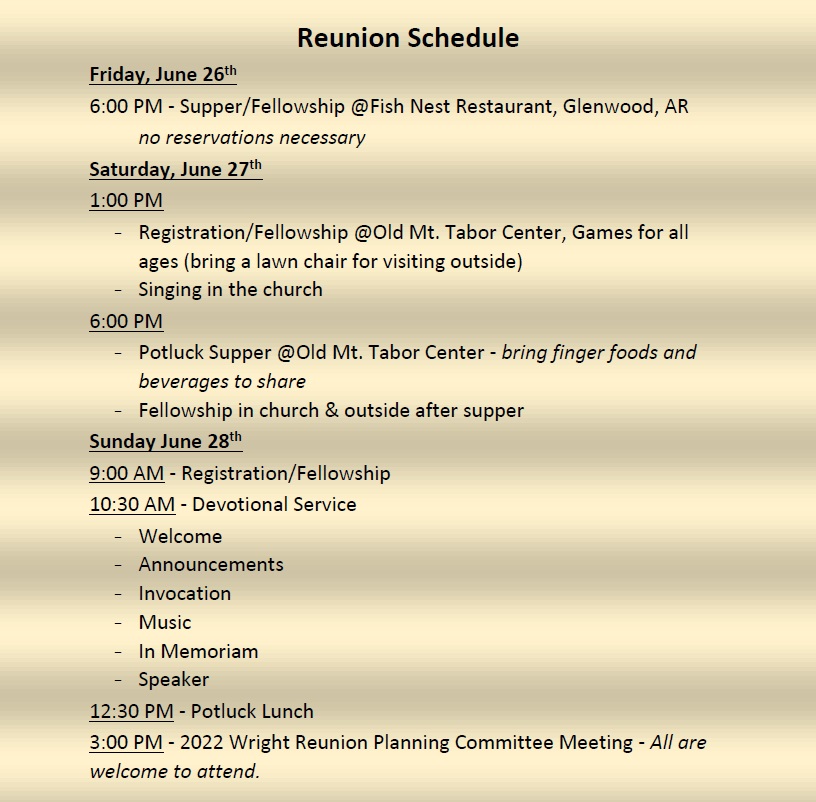
Please plan to attend. If you’re from out of town, lodging is available all around Glenwood!
 The Wrights of Montgomery County Arkansas